

Symbiosis of voices and instruments in the 17th century
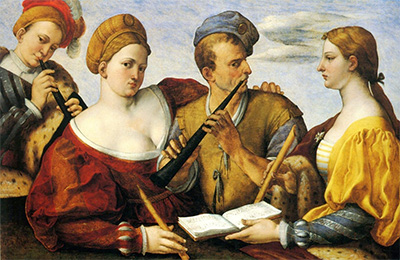 "I heard the best music I had ever heard, both in the morning and in the afternoon, of such delicacy that I would walk a hundred miles at any time to hear something like it (…) The feast was mainly celebrated with such delicate vocal and instrumental music, so delicious, so rare, so admirable, so sovereignly excellent that it entranced and astonished all those foreigners who had never heard of anything like it. Sometimes there were from sixteen to twenty singers who sang all together under the guidance of their teacher or director, and to their singing was added the music of instruments, ten trombones, four cornettos and two violas of extraordinary size…"
(Thomas Coryat, traveller, visiting Venice in 1608 during the celebrations for San Rocco)
In the seventeenth century, to celebrate with due pomp the civic-religious celebrations and liturgical functions, it was customary to involve a large number of musicians who accompanied the complex ceremonies, performing both vocal and instrumental music.
At the time, in Venice, the musical apparatus was of unpaired quality, including the most renowned chapel masters of the ducal basilica and the most virtuous singers, cornetto players, violinists and trombonists who performed to pay homage to the patron saints and during the devotional celebrations of the many churches of the city.
It is in this flourishing period that the links between singers and instrumentalists are indissolubly established: the most demanded virtuosos were in fact those who could best imitate the human voice, not so much in terms of sonority, rather for the ability to articulate like the human voice, to "speak" through the instrument.
This stems from the praxis, in use thorough the whole XVIc. of doubling or replacing with instruments the voices of a vocal ensemble.
This practice brought to life real musical duels, where voices and instruments flourished melodies with diminutions, variations, embellishments and trills.
At the beginning of the XVIIc., instruments acquired their own autonomy, developing a specific solo and chamber music repertoire in dialogue with one or a few voices: in this age flourished the concertato motet.
Vox humana by Seicento Stravagante with the soprano Silvia Frigato is an excursus that traces the development of the interactions between voices and instruments in the early Baroque, through the execution of concertato motets for solo voice, cornetto and continuo, virtuoso divisions and sumptuous organ literature of the most representative composers of the Italian school.
Giulia Bolcato - Soprano
Seicento Stravagante:
David Brutti - cornetto, cornetto muto and recorder
Nicola Lamon - organ, harpsichord and regale
Program
Anonimo
Intonazione del Settimo tono
from “MS. 40615” ca. 1655
Nicolò Corradini (ca. 1585-1646)
Spargite flores - Soprano & Violino overo Cornetto
from "Mottetti a 1, 2, 3 e a 4 Libro primo” Venice, 1613
Giovanni Martino Cesare (ca. 1590-1667)
La Foccarina A 1 Cornetto solo
from “Musicali melodie” Munich, 1621
Girolamo Frescobaldi (1583-1643)
Canzon sesta
from “Fioretti Musicali” British Library, ms. Add 40080
Claudio Monteverdi (1567-1643)
Pulchra es
from “Sanctissimae Virgini Missa senis vocibus ac Vesperae pluribus decantandae” Venice, 1610
Adriano Banchieri (1568-1634)
O quam pulchra est, a dui parte uguali
from “Vezzo di perle musicali” Venice 1610
Biagio Marini (1594-1663)
Sonata per organo e violino o cornetto
from “Sonate, symphonie, canzoni… Op. 8” Venice, 1628
Girolamo Frescobaldi (1583-1643)
Toccata decima
from “Toccate e partite d’intavolatura, Libro II” Roma, 1627
Francesco Cavalli (1602-1676)
Cantate Domino
from “Ghirlanda Sacra” Venezia, 1625
Giovanni Paolo Cima (1570-1622)
Surge propera - à Doi Soprani in Ecco.from “Concerti Ecclesiastici” Milano, 1610
Vincenzo Pellegrini(1562-1630)
Canzon detta la Cassiodora
from “Canzoni de intavolatura d’organo” Venice, 1599
Tarquinio Merula (1595-1665)
Nigra sum. a 2. Canto e Violino
from “Pegaso opera l’undecima” Venice, 1640
Tarquinio Merula (1595-1665)
Gaudeamus Omnes. a 2. Canto e Violino
from “Pegaso opera l’undecima” Venice, 1640