

Seicento Stravagante has been recording Renaissance and Baroque music for cornett and historical keyboards since 2022, in duo and in collaboration with other artists.
Seicento Stravagante’s albums highlight authentic instruments from XVI and XVII c. such as the organ by Paolo Pietro da Montefalco from 1509 located in Trevi (Perugia), the Cipri from 1578, in San Giovanni Battista’s church - Monte San Giovanni (Bologna) and the Venetian school organ from 1660, located in Caprile (Belluno) at San Bartolomeo’s church.
VIOLINO òver CORNETTO
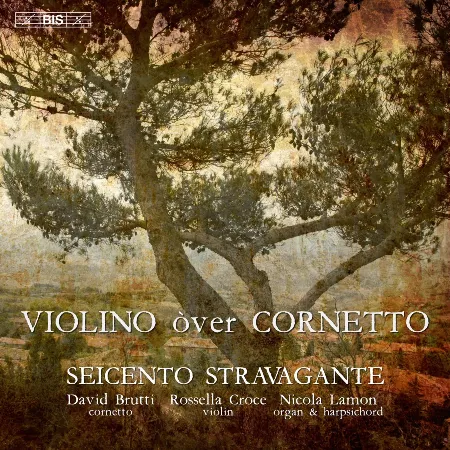
In the sixteenth century, the quality of a ‘civil conversation’ was a topic of great interest, both within learned academies and in the verbal games of convivial banquets.
As musical virtuosi learned how to ‘speak’ through their instruments, it was only natural that they would also begin to ‘converse’. After a much acclaimed release in 2023, Seicento Stravagante give us another example of musical conversation, this time between three musicians.
In works by thirteen Italian composers from the late 16th and early 17th centuries, the musicians of Seicento Stravagante, recreate the extravagance of early baroque music, when composers wove many individual ‘voices’ (whether vocal or instrumental) into a harmonious whole.
While the compositions could often be played on instruments of various kinds, it was on the violin and cornetto that they could shine most brightly, and the two instruments developed an increasingly close relationship, to the point that they were virtually interchangeable.
This recording allows us to appreciate the subtle blend of colours of these two instruments and the richness of Italian instrumental music of the period.
Reviews:
“Cornettist David Brutti (also an accomplished saxophonist) brings all the spontaneity, pliancy and virtuosity of jazz to these accounts – not to mention a rich-toned lyricism, revealing why the cornett was prized for its affinity with the human voice.” Music Magazine
“In tonal terms, Croce’s brighttoned, gutty stringiness meets Brutti’s combination of softness and edge highly sympathetically… and if you want to hear their responsive and nicely balanced dialogue out on full display.” Gramophone
SEICENTO STRAVAGANTE
Music for Cornetto and Keyboard
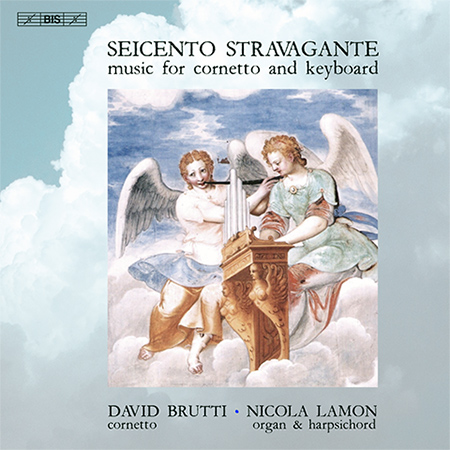
How to express emotion through music from which words are absent? This album attempts to give an answer to this question.
Through works by Italian composers from the late 16th and early 17th centuries, the two members of Seicento Stravagante, David Brutti and Nicola Lamon, demonstrate the extravagant styles of early baroque music.
During the decades surrounding 1600, the dominance of the human voice and of texts came to be replaced by the unfettered imagination of the composers-performers that allowed instruments to ‘speak’ on their own, and not only support a sung text.
At first the polyphony of the original vocal piece was simply supplemented with ornaments to compensate for the lack of text, but later, as the borders between vocal and instrumental music became quite fluid, the vocal lines would be transformed into virtuoso instrumental solos.
By the third decade of the seventeenth century, composers and performers were developing a new and independent instrumental style, which allowed them to freely mix intricate polyphony, dance-like passages and emotionally charged musical phrases.
Brutti perform this selection of works, published between 1584 and 1650, on three different types of cornetto, while Lamon alternates between a copy of a harpsichord from 1681 and no less than two historic organs, from 1578 and 1660 respectively.
MAURIZIO CAZZATI
Motets & Sonatas — Mauro Borgioni & Seicento Stravagante
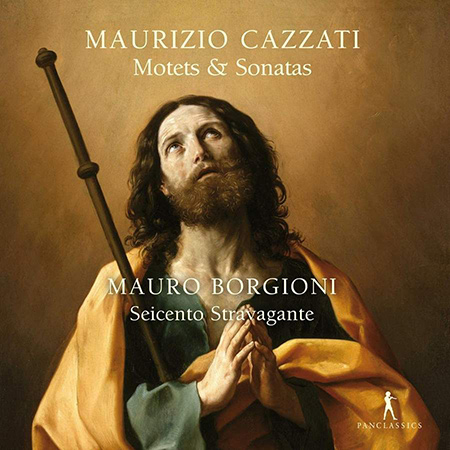
Maurizio Cazzati (1616-1678) is one of the most under-recognised Italian composers of the 17th century, although he was certainly one of the most prolific: 66 volumes (!) of printed music were published by him - almost 2000 individual compositions across all genres of his time.
Cazzati worked at various courts and institutions in northern Italy, reaching his professional peak as maestro di cappella at San Petronio in Bologna and his last years in the service of the Gonzaga dukes in Mantua.
His fate was probably to have been born a generation after the great innovator Claudio Monteverdi, whose style he consistently adopted and developed.
From today's perspective, however, Monteverdi casts such a large shadow that an entire generation of outstanding composers is obscured by it.
So it is all the more praiseworthy that the outstanding Italian bass singer Mauro Borgioni is now dedicating an entire CD to the composer Cazzati.
The focus is on solo motets for bass with concertante voices, for which he has enlisted the Ensemble Seicento Stravagante with organ, cornett and violin. The vocal works are complemented by instrumental sonatas by Cazzati.
IL CORNETTO DEL DOGE
Music in the Venice Renaissance
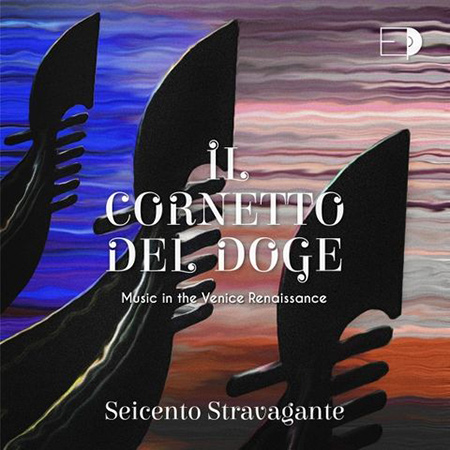
During the Sixteenth Century, Venice was the musical capital of Europe and the Basilica of San Marco, the private chapel of the Doge, was the ideal venue for such splendid performances.
'Il Cornetto del Doge' (Music in the Venice Renaissance), debut album of the ensemble Seicento Stravagante (David Brutti, cornetto & Nicola Lamon, organ), aims to evoke the astonishment and the wonder of the travelers who flocked to San Marco to listen to the most acclaimed and skilled cornetto players of the time such as Giovanni Bassano and Girolamo Dalla Casa and to the renowned organists of the Basilica, Andrea and Giovanni Gabrieli.
Recorded on an instrument of 1509, remained since then almost unchanged - the splendid organ of Paolo Pietro da Montefalco located in Trevi (Perugia, Italy) - this release represents, like a time machine, an extraordinary chance to listen to the music resounding in San Marco for the Doge of Venice.