

Luigi Zenobi from Ancona, virtuoso, poet and gentleman
 The Milanese painter Gian Paolo Lomazzo, in his “Trattato dell’arte della pittura, scoltura et architettura” (Milan 1585) mentions the most prestigious musicians of the time. There were composers (“concento delle voci”) such as Adrian Willaert and Gioseffo Zarlino, the organists Annibale Padovano and Claudio Merulo, the lutenists and lyre players, including Alessandro Striggio, gamba players like Riccardo Rognoni, and, in the end, he quotes "Luigi Zenobi Anconitano” among the most skilled cornettists.
Cornetto virtuoso and poet, Zenobi was born in Ancona around 1547. In 1573 he was recruited at the court of Albert V of Bavaria, where Orlando di Lasso was “Maestro di Cappella”. There he gained his Knighthood (1583).
In 1589 he was hired at the court of Alfonso II d'Este in Ferrara, where the famous "Concerto delle Dame" was active: an ensemble of singing virtuosos who inspired composers such as Luzzasco Luzzaschi and Luca Marenzio. In 1594 he was invited to the wedding of Eleonora d'Este and Gesualdo da Venosa in Ferrara. Zenobi, while having a high reputation, did not publish any musical compositions, nor treatises on practice and ornamentation, as many of his colleagues did.
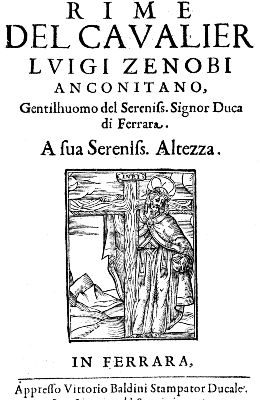
The most important legacy of Zenobi, in addition to a collection of spiritual poems (Rime, 1589), is represented by his “Letter", a precious text of musical practice of the time in which he illustrates the "qualities of the perfect musician". The qualities of a good cornetto player should be similar to those of a good soprano, who "has the obligation, and the free field to play, to joke, and in short to embellish a musical composition, but if this does not with art, with loveliness, and with judgement, it’s boring to hear, hard to digest, and sickly to bear”, while "Those of the Lute, and of the Harpsichord, and of the Harp, are discovered in the sweetness, promptness, cleanliness and agility of the hand, in the excellence of the fantasy, and should dominate counterpoint as a Maestro…".
Concerning wind instruments, Zenobi also insists on delicate sonorities: valiant are the musicians who know how to play softly and gracefully, as is the custom in the Prince’s rooms. The Marquis Vincenzo Giustiniani offers us a testimony of Zenobi's qualities: "Then there are many players of other instruments, which I am not going to name, except for Cavaliere Luigi del Cornetto from Ancona, who miraculously played it, and among other things many times it played in one of my dressing rooms above the harpsichord, which was tightly closed and could hardly be heard; and he played the Cornetto with such moderation and accuracy, that he amazed many gentlemen who enjoyed music, who were present, since the Cornetto did not surpass the sound of the Harpsichord.”
The program includes vocal and instrumental works by composers who evoke the biographical events of Luigi Zenobi, adorned with diminutions, both improvised and written by the most famous cornetto players of his time, such as Giovanni Bassano and Girolamo dalla Casa.
Seicento Stravagante:
David Brutti - cornetto, cornetto muto
Nicola Lamon - harpsichord
Program
Claudio Merulo (1533-1604)
Canzon prima “L’Olica”
from “Canzon di diversi per sonar…” Venezia, 1588
Giovanni Ferretti (ca.1540-post. 1609)
Dolci colli fiorit' a me si cari
from Il secondo libro delle canzoni a sei voci” Venezia, 1575
Cipriano De Rore (ca. 1515-1565)
Ancor che col partire - diminuito da Riccardo Rognoni
from “Passaggi per potersi esercitare nel diminuire” Venezia 1592
Annibale Padovano (1527-1575)
Ricercare del sesto tono alla terza
from “Il primo libro de ricercari a quattro voci” Venezia, 1556
Orlando Di Lasso (1532-1594)
Susanne un jour - dim. di G. dalla Casa
from “Il vero modo di diminuir” Venezia, 1584
Carlo Gesualdo da Venosa (1566-1613)
Canzon francese del Principe
from “Br. Mus. MS Add. 30491”
Girolamo Frescobaldi (1583-1643)
Toccata per Spinettina e Violino
from “In partitura il primo libro delle canzoni” Roma, 1628
Luzzasco Luzzaschi (1545-1607)
Aura soave, A uno soprano
from “12 Madrigali per cantare e sonare” Roma, 1601
Luca Marenzio (1544-1599)
Madonna mia gentil - diminuzione di G. Bassano
from “Mottetti, Madrigali, et Canzoni Francese diminuiti” Venezia, 1591
Alessandro Striggio (1540-1592)
Invidioso Amor - diminuzione di G. Bassano
from “Mottetti, Madrigali, et Canzoni Francese diminuiti” Venezia, 1591
Adrian Willaert(1490-1562)
Io so che bien vivete, su testo di L. Zenobi
from “Motetti, madrigali et canzone francese” Venice, 1591
Giovanni Agostino Veggio
L’Accorta
from “Primo libro de madrigali, a quattro voci” Parma, 1575
Anonymous XVI c.
El Bissone
from “Manuscript, D-Mbs Mus.ms. 1503 h”